Dyslexia Spelling Problems : Help at Home to Overcome Dyslexia
Did you know that dyslexia spelling problems are most difficult to overcome?
On this page I’ll share programs that are used by parents in the Learning Abled Kids’ Support group as well as tips for helping your child overcome his dyslexia spelling problems.
First: A Quick Dyslexia Spelling Training Tip
After you’ve just about given up on teaching your child to spell.. There is a proven way to help spelling stick. When I was researching the most effective method for making spelling “stick,” The research showed that a Self-Correction Method For Dyslexia Spelling Problems is THE key to long term spelling retention for many students who struggle with spelling. Check it out!
Effective Dyslexia Spelling Programs
Along with the Self-Correction Method For overcoming dyslexia spelling problems, I recommend All About Spelling, followed by Megawords, then The Phonetic Zoo,
Direct instruction to overcome dyslexia spelling problems is vital in helping a child with dyslexia to overcome his spelling difficulties. It takes a lot of direct instruction and repetition. Therefore, I’ve found that teaching a child with dyslexia to spell well often requires more than one program.
As you probably know, children with dyslexia are notoriously bad spellers. Teaching a child with dyslexia to spell requires diligence and the usage of multisensory programs that provide specific, sequential, direct instruction in all aspects of spelling.
Often, teaching a child with dyslexia spelling problems can produce added reading ability too. There are several specific, sequential programs for teaching kids in order to overcome dyslexia spelling problems I’ve listed some great spelling programs below.
If you want to know more about the Self-Correction Method For dyslexia spelling problems, you may want to visit our What Works: Self-Correction Method For Spelling page.
Frequently Used Programs For Overcoming Dyslexia Spelling Problems
All About Spelling is possibly the BEST program I have reviewed, and I think it is a fabulous choice for children with dyslexia because it incorporates Orton-Gillingham practices in the instruction. I think the program would be highly effective for children with spelling problems, and even if they’re considered “typical” children with no known learning disabilities. Disclaimer: I received Levels One through Four as free examination copies. I have not personally used the program with my own children because we had already remediated my boys’ dyslexia spelling problems prior to the publication of All About Spelling.
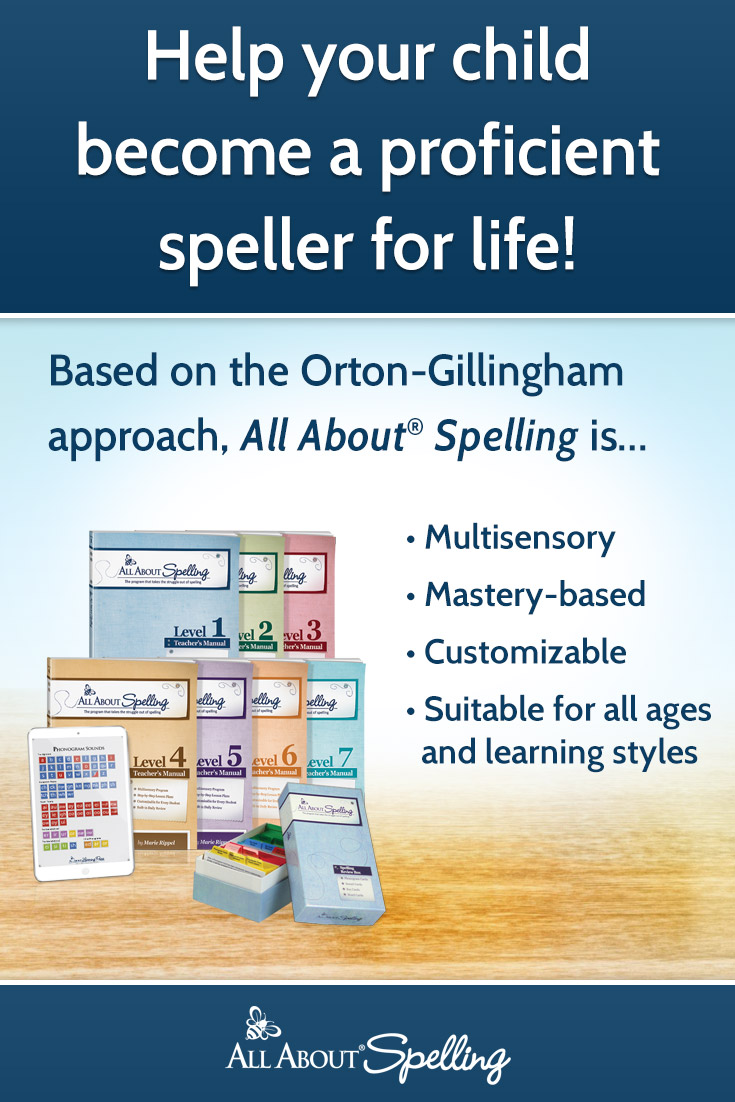
All About Spelling is the most comprehensive, multisensory, explicit, direct instruction program for working to overcome dyslexia spelling problems I have seen. It is designed specifically to teach spelling skills to children with language-based learning disabilities like dyslexia or auditory processing disorders. The teaching methods in the program are based upon Orton-Gillingham methods. “All About Spelling” is a step-by-step program with plenty of instruction provided to the teaching parent so you will understand how to use the program effectively.
What stands out to me is this program can be MORE than merely a spelling program. In a similar manner to the program “Spell to Write and Read
ENcoding–taking words out of the brain and writing them on paper, which is spelling–is a more difficult task than DEcoding–recognition of words already on paper for reading. Decoding (reading) requires recognition and recall, whereas encoding (spelling) requires recognition of individual sounds within a word, recall of letters that represent the sound, followed by application of specific rules to determine which actual letters to use, and writing the letters (word) on the paper.
Therefore, if a child can learn to spell well, he will likely learn to read too! Using an Orton-Gillingham spelling program like “All About Spelling” will provide instruction using methods proven to work for children who have dyslexia.
“All About Spelling” begins with the first required skill for spelling (and reading)–sound recognition and knowledge by teaching sound-symbol relationships prior to attempting to teach word construction for spelling.
Mastery of Spelling Skills For Kids with Dyslexia Spelling Problems
Mastery of the sound-symbol relationships is critical for success for children who have dyslexia or other learning disabilities.
The levels in “All About Spelling” are laid out perfectly, with mastery of each step being advised before moving on to the subsequent step. If a parent uses this program as designed, and INSURES mastery of each step prior to moving to the NEXT step, then it would be unlikely that a child would fail to make fabulous progress in dyslexia spelling problems. The only short-coming I see in the program–and it is a small one–Is I do not feel there are strong enough warnings to parents at the end of each step–Be SURE your child has MASTERED this step prior to moving to the next step. Parents may be tempted to move ahead rather than review enough times to insure mastery.
Mastery means AUTOMATIC and CORRECT recall of a skill, concept, or rule, without hesitation and without guessing. Each step must be mastered to this level prior to proceeding to the next step. IF this program ever failed to teach a cognitively-capable child to spell and read, it would likely be due to implementation errors (not following the program as directed) or moving through the program too rapidly–before the child has mastered each step.
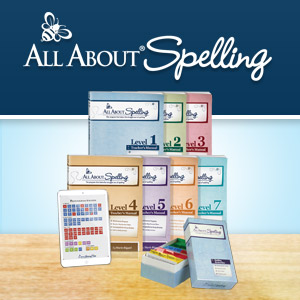
As a step-by-step program, “All About Spelling” cannot be beat for both cost and quality. To me, it is a viable substitute for expensive, scripted reading programs such as Wilson and Barton. “All About Spelling” has added emphasis on applying rules when spelling because it covers more than the recognition-recall needed for reading. Additionally, the program has teaching prompts for the teacher/homeschooling parent, which makes this program easier to use than most other multisensory spelling programs. If I were starting to teach my child TODAY, “All About Spelling” is THE program I’d want to use.
Megawords
We bought and completed all eight levels of the Megawords series. This program improved my child’s dyslexia spelling problems more than any other stand alone program we used. ** Note, “All About Spelling” was not yet available when we began homeschooling, we used direct instruction provided by me along with Megawords.
Megawords is a comprehensive step-by-step program for grades 4 and up. A child MUST have basic elementary reading skills prior to using Megawords. This program teaches reading and spelling of multi-syllable words and it is very explicit, sequential instruction that does not assume the child will be able to fill-in-the-blanks. With additional multi-sensory activities in the teachers guides, this is one of the few programs that can truly help a child with dyslexia improve both their reading and their spelling. This would be considered supplementary instruction or as skill practice in addition to a good, solid Orton-Gillingham Reading Program.
Buy through Christianbook.com
Megawords on Amazon.com
The Phonetic Zoo
The Institute for Excellence in Writing sent us a free copy of this program for review. This is NOT a ‘beginning’ spelling program, and is a great follow-up program for either Megawords or All About Spelling. The words in the first level of The Phonetic Zoo
“When we look at a word we see it as a whole. But spelling is sequential, and the correct sequence can be missed when seen as a whole. Spelling the word out loud, letter by letter, ensures accurate storage of the correct sequence in the brain. Hence, auditory input is the best possible way to store spelling information accurately.” The program is primarily auditory in nature, but uses clever images and catchy phrases to provide children with memory triggers. “The Phonetic Zoo
Logic of English
“Logic of English” is an Orton-Gillingham based program that is comprehensive and multisensory. The program appears to be easy to use, and provides a lot of great resources like a phonograms app, tactile handwriting cards, sandpaper letters, etc., but buying all of the elements of the program would be expensive. This looks to be a great program for kids with dyslexia spelling problems as it is thorough and comes with a lot of helpful tools if you buy the whole program. The one thing about this program that you should know is that it is laid out with “days.” In other words, lessons are in a Day 1, Day 2, Day 3, etc. format. HOWEVER, it is critical to go at the pace of your child’s learning, NOT based upon a Day 1, Day 2, type of schedule. The program materials do say to make sure the child has mastered each level, but I think it’s all to easy to FORGET than you should not move on to the next “day” when the content for today’s lesson is yet to be mastered. That is the one thing I don’t like about this program. I think it is strong instructionally, but it seems like the Day-to-Day lesson layout is more geared toward classroom teachers who are more likely to move ahead day-by-day whether any single student is ready or not. Therefore, if you’re using this program at home, be SURE to move ahead only when your child actually remembers and is successful with this day’s content. It will go a lot better in the long run if you insure mastery as you go.
Additional Programs and Resources for Kids with Dyslexia Spelling Problems
An important factor for remembering how to spell a word is the auditory component. A child should speak spelling words out loud when practicing. A great resource for auditory practice is **SpellingCity.com – This is a clever and FREE website. I accessed and played around with it. I think it’s a fun way to have your child practice any spelling list you create. SpellingCity.com provides spelling practice through games and has humanly-spoken prompts. The games can add a ‘fun’ factor typically missing in spelling practice. There are a large number of spelling lists you can select from or you can create one for your child. When we first discovered SpellingCity.com, we spent time there “just playing”! I recommend making this site a fun part of your spelling practice routine. It’s not specifically written to address dyslexia spelling problems, but any practice you can get your child to do will help!
You might find my LearningAbledKids’ Phonogram Tiles (large download 317k) to be helpful when teaching word building and segmenting. I made the tiles when we were working on dyslexia spelling problems. This is a PDF document you can download and print. You can either print them on card stock, then cut them out, or you can print them on regular paper and use the peel’n’stick laminating sheets to make the tiles more durable and to make them slide around easily when manipulating. I printed them on card stock, laminated them, and then cut them out. They held up quite well! You can use these tiles for teaching your child many literacy skills.
Here are other programs for dyslexia spelling problems that may also be beneficial:
**Explode the Code – I bought a couple of used volumes of this program. This program is a comprehensive step-by-step program that aids a child with both spelling and reading from the most basic level. This program starts with the basics and is recommended for anyone beginning to work directly with a child. This is probably one of the most comprehensive commercially available programs on the market that won’t cost you an arm and a leg. If you combine the teachings of Explode the Code with multi-sensory methods, you will have a great program.
Buy through Christianbook.com
Explode the Code on Amazon.com
**Read, Write, & Type – Other group members have mentioned this program as a good one for working to overcome dyslexia spelling problems. In researching the program, I learned “This 40-lesson adventure is a software tool for 6-8 year olds just learning to read, for children of other cultures learning to read and write in English, and for students of any age who are struggling to become successful readers and writers. Children learn phonics, reading, spelling, writing, vocabulary, punctuation, and even keyboarding. Children see, hear, speak, touch, and move their fingers as they play each new level in this multisensory program.”
**AVKO Sequential Spelling
**Natural Speller
– Other group members have mentioned this program. In researching this program online, I found this is a sequential spelling program designed for children who don’t respond to “ordinary” teaching methods. “Everything necessary for spelling instruction for grades 1-8 is included in this book. Basic word lists are given for each grade with words containing similar patterns grouped together. Special word lists (e.g., calendar words, contractions, measurements, homophones, latin roots)) are also provided. Kathryn Stout strongly advocates keeping separate those words with similar sounds which are formed by different letter combinations (e.g., though, bow, sole). Lessons can be developed from the word lists or with words of your own choosing. Instructions are provided for teaching spelling and for studying words. (This is not a student text but a parent/teacher resource book.) Spelling rules are provided with charts that include suffixes and prefixes along with phonic and writing rules.”

**Multisensory Teaching of Basic Language Skills
**Writing Road to Reading
**Spell to Write and Read
**Teaching Phonics & Word Study in The Intermediate Grades – This is a program book I bought and LOVE. We used this as one component in our program to overcome dyslexia spelling problems. It is a detailed guide for teaching your child the ins and outs of reading and spelling. The book is geared towards students who know the elementary basics of reading and spelling (single letter sounds). If you are clueless about where to begin in helping your child move forward into the realm of proficient reading and spelling, then this book is a wealth of information to guide you.
Buy this book at Walmart.com
Teaching Phonics & Word Study on Amazon.com
** Spelling Power
Spelling Power on Amazon
** Spelling Workout
** Beyond the Code
** Dr. Fry’s Spelling
Buy through Christianbook.com
**Spelling Workout
**Phonics Pathways
**Spectrum Spelling – We’ve purchased and used a couple of the elementary level volumes of this program. The Spectrum Spelling program is an easy to use program that teaches the concepts behind word building. This enables a child to develop an understanding of how spelling works. Building on spelling skills will help with reading as well, although it is not designed specifically for dyslexia spelling problems.
Buy through Christianbook.com
McGraw Spectrum Spelling on Amazon.com
**Spelling by Sound and Structure (Rod and Staff Mennonite, Anabaptist Publishing) – Other group members have mentioned this program and I’ve researched it online. This spelling program is not based upon multisensory teaching methods, but is very sequential. The program teaches spelling from a number of angles–synonyms, antonyms, definitions, picture clues, context clues, and categories of words, phonetic patterns as beginning and ending sounds, long and short vowels, consonant blends, digraphs, double consonants, syllables, plurals, verb forms, Latin and Greek roots, etc. This program is better for correcting dyslexia spelling problems than most standard spelling programs.