
Orton Gillingham Method for Overcoming Dyslexia
What exactly is the Orton Gillingham Method or an Orton-Gillingham reading program?
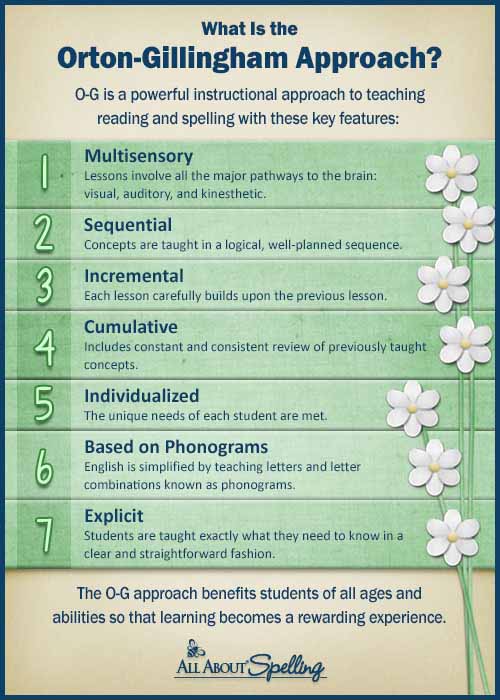
The Orton Gillingham method uses multisensory teaching to teach reading to kids with dyslexia. Multisensory instruction is a specific way of teaching children with learning disabilities, and particularly for overcoming dyslexia.
The Orton Gillingham method was created through the joint efforts of Samuel T. Orton and Anna Gillingham. Specifically, Orton-Gillingham reading programs incorporate specific, sequential, direct, multisensory instruction.
For children with dyslexia, this means they are taught every sound (phoneme) and the representative letter combination(s) that represent the sound, one at a time, in a specific order, in a small group, using multi-sensory teaching methods.
The multi-sensory, Orton Gillingham method of teaching may include tracing letters with their finger in sand as they say the sound (not the letter), or tracing the letter on the carpet with their bare feet as they say the sound, making the letters out of clay, or pipe cleaners, or using any other medium that allows them to hear, see, feel, and move while learning their sound/letter combinations.
When looking at reading, writing, or spelling programs for your child, you will find there is a wide variety of programs based upon the Orton Gillingham method of instruction. When thinking about the differences in Orton Gillingham programs, think of the Orton Gillingham methods as a set of multi-sensory activities. Each program that is based on Orton Gillingham methods is one type of program that fits within the set. Each program may or may not include instruction using all of the learning styles.
Some programs based on the Orton Gillingham method use picture cards for queues to help the child recall letters, but for some children this may be an extra step in their recall of the associated sound. Most programs also have differences in the order that phonemes are presented too, and no specific order is better than another.
The types of materials used and order of instruction are the most common variations between various programs based on Orton Gillingham methods. Probably the biggest difference in programs specific to teaching reading and spelling would be whether the program seeks to teach the child to “encode” or “decode” — Encoding is taking a sound you hear, recalling the representative letter combination(s), and writing them down on paper. Decoding is taking the printed word, looking at it, and determining what sound you should say. Encoding is spelling and decoding is reading.
So called ‘pure’ Orton Gillingham method reading programs primarily teach “decoding”. These programs teach a child how to read and provide some instruction in spelling, but the focus is READING.
Some programs primarily teach “encoding”. Two well known programs using the encoding approach are Writing Road to Reading and Spell To Write and Read. These programs primarily teach spelling and generally reading skills come along with it.
I found teaching decoding (reading) did not successfully bring about proper spelling. I am not convinced teaching encoding (spelling) first will always bring about reading, but I do believe teaching the encoding / spelling is more likely to bring about reading skills than the reading is likely to bring about good spelling abilities.
Children with severe dyslexia may very well require teaching from both directions, so I’d actually recommend approaching it from both sides. This would mean calling out the sounds (dictating) and having the child write down the letters; AND using flash cards to show the child the written phonemes and letting them call out the represented sound. By doing it both ways, the child’s learning is maximized. I’d actually do one, then the other, but not both at the same time.
For information on how to select an effective reading program based on Orton Gillingham methods, read “How to Find Effective Orton-Gillingham Reading Instruction Programs for children with dyslexia” or consider purchasing the Orton-Gillingham Manual. For a complete program, you can get the book and the corresponding drill cards. For training opportunities, you might consider these resources:
 **Gillingham Manual (Eighth Edition)
By Anna Gillingham & Bessie W. Stillman / Educators Publishing Service. The Orton-Gillingham method is a proven method for teaching kids with dyslexia how to read. The Orton Gillingham method is commonly used with children who have dyslexia. Based on extensive research about the learning styles of children with specific language disabilities, this Orton Gillingham method uses visual, auditory, and kinesthetic associations to help students learn sound-symbol relationships. The Gillingham manual is the definitive guide to using the Orton-Gillingham method. The Orton Gillingham manual covers reading and spelling, learning sound symbols (letters and letter combinations), spelling patterns, handwriting, and dictionary usage.
Within the Orton Gillingham method, these skills are addressed:
- Sound-symbol relationships
- Letter formation
- Spelling generalizations
- Dictionary use
- Short and long vowel sounds
- Digraphs
- Diphthongs
- Affixes and roots
- Word structure
- Consonant sounds
- Decoding and encoding words
**Institute for Multi-Sensory Education (IMSE) – “Based on the time-tested Orton Gillingham method of reading instruction, the Institute for Multi-Sensory Education (IMSE) offers a revised and expanded multi-sensory approach that provides students the opportunity for success and benefits every learner.”
 **Phonetic Word Cards
By Anna Gillingham & Bessie W. Stillman / Educators Publishing Service – This case contains 610 cards for use with any Orton Gillingham method approach to reading instruction. The cards are divided into 43 groups of phonic sounds. Single words and detached syllables are used to exemplify the important patterns and generalizations found in reading and spelling. The cards can be used for decoding practice, to introduce spelling rules and generalizations, or for dictation. They are organized sequentially beginning with CVC words and moving on to spelling generalizations, syllabication, and word structure. One case per student is recommended.
**The Academy of Orton-Gillingham Practitioners and Educators – See “Training Programs & Courses” on the main menu for continuing education programs relevant to using the Orton Gillingham method of instruction.
 **Gillingham Phonics Drill Cards (8th Edition, without pictures)
By Anna Gillingham & Bessie W. Stillman / Educators Publishing Service – The Orton Gillingham method is commonly used with children who have dyslexia and other reading disabilities. Based on extensive research about the learning styles of children with specific language disabilities, the Orton Gillingham method uses visual, auditory, and kinesthetic associations to help students learn sound-symbol relationships. These non-picture Phonics Drill Cards are organized into three sets of numbered cards, each set designated by a color. White indicates consonant phonograms; salmon indicates vowel phonograms; and yellow indicates sound symbols for spelling. The word and the sound symbol of the phonogram are printed on the back of the card. The teacher pronounces the sound, and the student names the letter or letters that spell the sound. One pack is recommended for each student.
—
